


Recirculating Aquaculture Systems (RAS) base their operational feasibility on rigorous control of water physicochemical parameters. Unlike open or net-pen systems, where effluents and uneaten waste disperse into the natural environment, in a RAS facility every gram of feed introduced directly interacts with the filtration subsystems.
In this context, the physical stability and cohesion of the pellet play a critical technical role in biofilter efficiency, water quality, and nutritional utilization.
1. Structural Integrity of the Pellet and Fines Generation
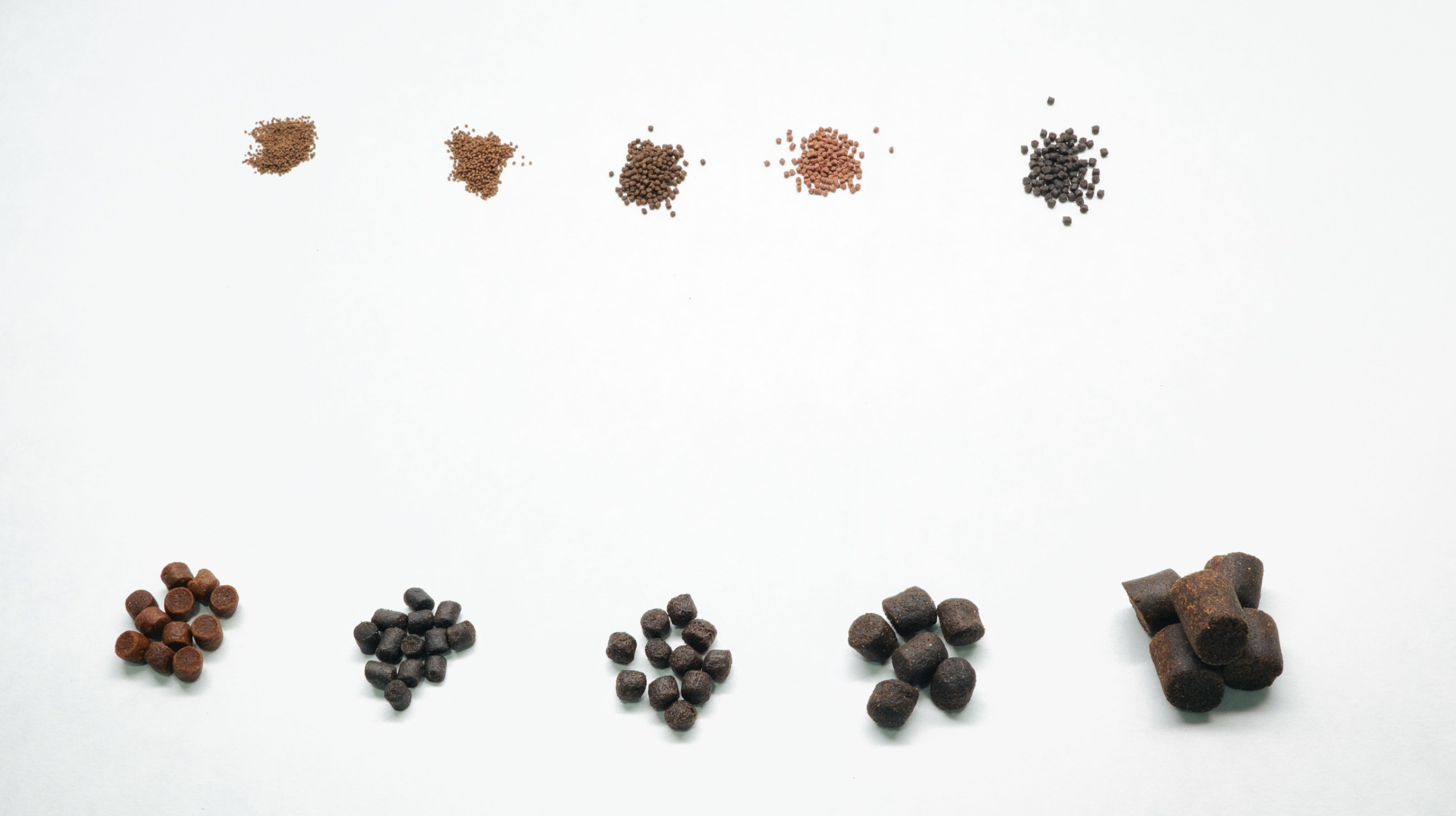
Pellet integrity is assessed through resistance to mechanical abrasion during handling, pneumatic distribution, and its behavior upon contact with water. When the cohesion of the extrudate is deficient, friction and impact generate suspended particles smaller than 100 micrometers, known as fines.
An unstable pellet undergoes two parallel processes upon entering the tank:
- Physical disintegration: Fracture of the pellet into microparticles caused by turbulence and fish swimming activity.
- Soluble leaching: Accelerated loss of water-soluble micronutrients, free amino acids, and minerals through leaching before the feed is consumed by the fish.
2. Impact of Organic Matter on Biological Oxygen Demand (BOD)
The accumulation of fines and uneaten feed directly increases the organic load in the recirculation loop.
- Increase in BOD: Dissolved organic matter in the water increases Biological Oxygen Demand (BOD), necessitating higher oxygenation rates in the system to sustain adequate levels for fish metabolism.
- Proliferation of heterotrophic bacteria: Soluble solids and suspended organic matter are consumed by heterotrophic bacteria in the water column and on the surfaces of the biofilter media. Heterotrophic bacteria have a significantly faster growth rate than nitrifying bacteria, resulting in direct competition for available oxygen and physical space on the filter carrier or substrate.
3. Inhibition of Nitrification in Biological Filtration
The biofilter relies on two primary groups of slow-growing autotrophic bacteria: Ammonia-Oxidizing Bacteria (AOB) and Nitrite-Oxidizing Bacteria (NOB).
The excessive presence of fine organic solids impairs the nitrification process through three mechanisms:
- Fouling and coating: Suspended solids of smaller particle size can deposit onto the biofilm, suffocating nitrifying colonies.
- Competition for dissolved oxygen: Heterotrophic bacteria deplete the oxygen required to convert ammonium ($NH_4^+$) to nitrite ($NO_2^-$) and subsequently to nitrate ($NO_3^-$).
- Total Ammonia Nitrogen (TAN) accumulation: If the biofilter loses nitrifying capacity due to organic interference, dissolved TAN levels in the water rise, reaching concentrations toxic to fish and compromising growth rates and feed conversion.
4. Nutritional Value Loss and Feed Conversion Ratio (FCR) Deterioration
From a nutritional perspective, physical feed degradation prior to ingestion directly affects production efficiency:
- Loss of essential nutrients: Leaching diminishes the actual nutritional profile ingested by the animal, altering the amino acid and energy balance targeted in the formulation.
- FCR deterioration: Disintegrated, unconsumed feed is technically accounted for as delivered feed, artificially inflating the Feed Conversion Ratio (FCR) and driving up the cost per kilogram of biomass produced.
Solutions through Precision Extrusion
At Dibaq Aquaculture, the formulation and processing of diets tailored for RAS prioritize precision extrusion technology to ensure pellet cohesion. By fine-tuning starch gelatinization, matrix density, and pellet hardness, a feed is achieved that minimizes fines generation and withstands water residence time without losing its physical structure—safeguarding both the investment in biofiltration and harvest yield.